I spent yesterday at Regent’s College, sitting in a lecture theatre, being inspired about filmmaking by Chris Jones, scribbling pages and pages of notes. It was the Guerilla Filmmakers Masterclass. I tried to tweet tidbits during the presentations, but my phone decided I can’t connect to the internet with it (gee, thanks, phone).
I can thoroughly recommend Chris’ workshops and his blog chrisjonesblog.com. I had previously attended a Producing Masterclass with Chris two years ago, when I had first arrived in London. He is a great speaker and comes from a position of expertise and humility.
One of the best parts of the course today was outlining the five stages of a filmmaking career. At the Producing Masterclass two years ago, the five stages of a Producer’s career were outlined as well. I can safely say that I am a Stage Two Producer. Great tips for this stage and how to advance to the next.
Chris also posited that, within the industry, there is no longer the dichotomy between Amateur and Professional, but there is now a third category: the non-professional expert. These are the filmmakers who have a day job and make films in their spare time. That’s me! It was great to look into that model and affirm that it works – albeit with years of hard work – and to recognise it as a part of the industry.
It has been great networking with fellow filmmakers. I have already made some useful connections with people with whom I would like to collaborate in future.
I wrote pages and pages of notes. I’m looking forward to the second half of the masterclass today. Maybe I’ll even be able to tweet?
Today is the last day of filming “Skip School“, a web series about Alex, who struggles with the time jumps of his new school. I have been producing for the students in my course, so they can experience being on set.
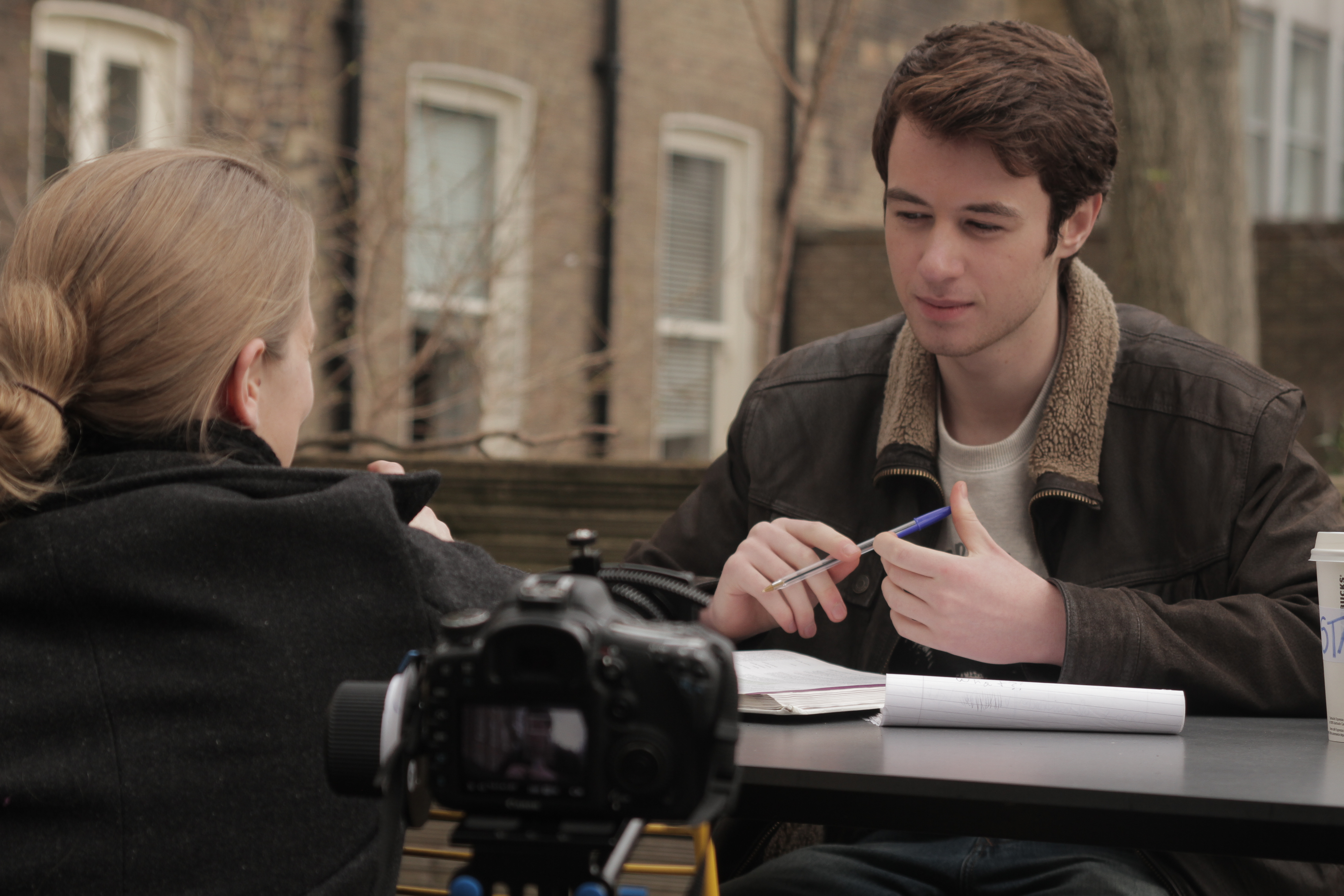
Here is a photo of me directing our Alex, played by Ben Grady. The photo was taken by one of the students (lovely shot composition, innit?).
Yesterday was the screening of the third Action On The Side project. In February 2014 we made two short films: ‘Office Ugetsu’ and ‘Escape’. Both films were screened to a group of 30-35 at Hult House. We also screened the updated cut of ‘WhosApp’, which was made as part of the October 2013 AOTS.
Office Ugetsu is now online for your viewing pleasure. Please check it out.
The other films will be online in due time.
I am learning a lot with the course that I am lecturing at Hult (BUS 340 Practical Film Producing). As part of the course, the students are getting an on-set experience. For this, I am producing a web series. The three episode series is called ‘Skip School‘. It follows Alex, a naive 19-year-old, struggling with the time jumps of his new school. I have a very short turnaround time for this project (the script was only finalized last week), so am currently confirming cast and crew.
The series will be shot on Saturday 01, Sunday 02, and Saturday 08 March in Bloomsbury.
I’m contacting people, and am about to start advertising on all the casting and crewing websites. If you’ve stumbled across this post from one of those, and you have any questions on the project or want to suggest someone for a role, please flick me a message (asap, ideally before the end of Tuesday).
This post was written in January 2014, and stayed in my drafts folder for a long long time. I’m posting it retrospectively.
Tomorrow is the first lecture for my BUS 340 Practical Film Producing course at Hult International Business School.
I have a really amazing bunch of students. I unfortunately missed the first week of class – as I had to be in Dubai for our Global Powwow – so the first week of the course has been online. Students have introduced themselves online and have completed a little quiz (just a multiple choice asking them why they’re doing the course). I had set three films to watch before we meet tomorrow: ‘Lost In La Mancha’, ‘The Kid Stays In The Picture’, and ‘Side By Side’. They have been commenting on them on a discussion forum, and I think I only scared off a couple of them 😀
And, finally, I asked the students to share two short films that they enjoy, to share what they like about it. Some of these students never watch short films. It’s brilliant – they’re getting an opportunity to watch a load of films. They’re seeing different genres and stories. I’m watching every one – which may have been stupid, because I have hours of shorts to watch. But it’s brilliant, because I have hours of films to watch!! I’m loving it. And also, they’re sharing films from their country – it’s an International school, so the students are from all over. I’ve watched an amazing film from Kenya about Somali pirates, a Greek short about a father and son, and I’m about to watch a Dominican short.
I’m looking forward to the class tomorrow.
You can follow the hashtag #practicalproducing on twitter during the course for tips.
The WordPress.com stats helper monkeys prepared a 2013 annual report for this blog.
Here’s an excerpt:
A San Francisco cable car holds 60 people. This blog was viewed about 3,600 times in 2013. If it were a cable car, it would take about 60 trips to carry that many people.
I thought, why don’t I make a video with my achievements for 2013. Then I could share it with my friends online. It could be a new tradition.
Then I realised I don’t have enough time!
So, here is the new tradition. The reflection on a year gone by.
Film
Co-Produced and 1st ADd two films with Shiftwork Productions which were shot in December but completed in 2013 (‘Now Wash Your Hands’, ‘Don’t Do It’)
1st ADd & Co-Produced ‘The P.A.’ with This Big Productions
Started Production Managing/1st ADing/Co-Producing ‘All I Do Is Dream’
Had four films entered in the Virgin Media Shorts Competition (‘The P.A.’, ‘Now Wash Your Hands’, ‘Don’t Do It’, ‘Tragedia’)
Screened ‘Tragedia’ at Whirlygig Cinema’s Making Tracks (My first Q+A)
Screened ‘Tragedia’ at KinoLondon #57
Had a second interview with Adelaide Screenwriter published online
Co-Produced / 1st ADd ‘The Estate Agent’ with Shiftwork Productions
Produced and Directed ‘Dead Letter’ with Shiftwork Productions
DPd ‘The Meeting Place’
DPd my first feature film. Got fired from the same feature film. Learnt a lot from the experience, including who not to work with, research who you’re working with, and don’t assume that people who are making a feature have gained experience from shorts or other projects.
‘Copper’ completed with an update. ‘A Party For Me’ is very very close to completion. Starting entering these into festivals.
Took part in the inaugural Action On The Side in July 2013. Produced ‘Elle Fatale’.
Started helping James to run Action On The Side. Helped run Action On The Side in November 2013. Produced and wrote ‘WhosApp’; 1st AD’d & Co-Produced ‘Facetracker’.
Production Managed and 1st AD’d (pick-ups) of ‘NightStrike’ with This Big Pictures
Worked on the London Film London Calling application for ‘
Attended the BAFTA New Filmmakers Market and the Screen Film Summit.
Attended networking events and met loads of filmmakers.
Started teaching (see Career below)
Dance
Performed with the Arab Quarterly at the Hoxton Hall (London Belly Dance Debut)
Took Teachers Training Workshops and Dance Performance workshops with Elis Pinheiro
Took weekly classes with Farah Nasri
Performed with Farah’s class at the Bellydance Trophies
Joined and performed with the London Algerian Ballet
Completed a Performance Development Course with Ozgen
Took numerous workshops and attended numerous performances
Travel
Went to the Global Powwow in Dubai
Attended the CAMS Conference in St Louis
Filmed a friend’s wedding in Bristol
Returned to New Zealand for a week. Sorted things out at the house and with films; caught up with friends and family.
Spent Christmas with friends in Inverness
Career
Attended the Global Powwow in Dubai and the CAMS Conference in St Louis
Scheduled the entire 2013-14 Academic Calendar before registration for FA2013
Promoted to Registrar of the Undergraduate Program
Got a new Assistant Registrar
Successfully implemented Online Registration for FA2013 (200+ students in September, 700+ students in November/December). Included running training sessions for students and staff, my team creating statuses and uploading worksheets for all 700+ students.
Started teaching: taught one Independent Study on Film Production Assisting and one Independent Study on Scriptwriting.
Hired to teach a course on Practical Film Producing in Winter.
So often on social media, we all promote our best times and fail to mention our worst. From the outside, our lives are awesome. But some people had a crappy 2013 and just want it to be over. I think it is important to reflect on the crappy as well. Our lives aren’t all perfect, and it is important to talk about the bad stuff too. So, a few of of the downers.
Got fired from my first feature: this was a major learning experience. The Producer still owes me over £600 for the days I worked. Never trust people who want you to work without giving you a contract.
I filmed too much stuff that I have not had the time to edit. I unfortunately still do not have the time to edit it, or the money to pay someone to edit it.
I picked up too many projects: I hit my limit towards the end of the year, and have been declining projects until I finish a few.
There are some people I will not be working with again or at least for a while.
Didn’t get to see enough movies. Am especially gutted for not supporting the Independent Film Industry enough by seeing Indie Films at the cinema.
I still haven’t worked out my work/life balance. I have had a few too many nights working till 8pm/9pm/10pm/11pm with the day job, due to short-staffing and over-work. I work long hours at the day job without a break, then do a dance class then a production meeting. The way I see it is I am building my careers.
I spent too much time on tumblr and not enough time exercising. Man I wish I kept up doing yoga or pilates every morning.
I ran late and took too long to do things too often.
Here’s what I’m looking forward to in 2014
Teaching my Practical Film Producing course in WI2014. Producing a short alongside the course.
I am currently prepping the course that I am teaching in Practical Film Producing in January. One of the issues that I am thinking about is the issue of paying people: cast and crew.
As a Short Film Producer, I am often working on a micro-budget. Some films may be self-funded (e.g. by the Director). Some may have a budget from a client. Some we have raised funds from crowd-funding.
The problem with a solely self-funded film is that you don’t have an external assessment. You are making the film for you rather than for the audience, and you and your decisions are not liable to an investor. For this reason, Producers should not be putting up their own funds – they must find external investment.
The Producer creates the budget. In micro-budget films, the above-the-line costs usually get waived (scriptwriters fee, director’s fee, producer’s fee). Why should you get paid if no-one else is? Then you use your script breakdown to plan the rest of the budget. You will be looking at locations (permits, transport), crew (who do you need, on how many days, catering), equipment (incl. kit fees), post-production and deliverables, marketing and distribution. In my experience, the largest costs are catering and transport(1). Many micro-budget filmmakers would rather that the money that is spent appears on-screen. They will spend money on camera and lighting equipment, and will ask their crew to work for free. Some filmmakers will pay the talent before paying the crew, because the performance will be on-screen.
How is this sustainable? At the Guerilla Filmmakers Producer’s Masterclass, Chris Jones and Stephen Follows introduced that there are five stages of Producing.
The first stage: Basic Production.
You’re learning the ropes. You’re helping out on productions.
The second stage: Practical Producer.
You’re producing your first micro-budget shorts with no commercial value. You are entering the films into film festivals and competitions. You might even make a micro-budget feature.
The third stage: The Attempt At The Summit.
You make the breakout film. You’re getting investment.
The fourth stage: The Creative Producer.
Your film company is a profitable small business. You make the game-changer film.
The fifth stage: The Prolific Producer.
You are in control
In stage one, you’re going out and making films with your friends. It is easier to ask friends to work for free. They know you and your passion and you can make it up to them in other ways. As you make more and better projects, you build your network and the amount of people who you can ask to work on your project. Crew that are asked to work for free are being approached by Stage 1 and Stage 2 Producers.
Now the (often unsaid) agreement is that the people you work with on unpaid films are the ones that you will hire as soon as you are paying. You learn filmmaking by doing it, and filmmaking is a collaborative medium, so you do have to rely on other people to help you to gain experience. You work with people on the unpaid projects, and, if you get on and like them, you’ll hire them again.
But that means that people can go for years before getting paid, and years before earning a living wage.
Filmmaking is the only industry I know that does this.
Now, this is Independent Film. If one got a paid job in filmmaking (such as with a studio or a post-production house), then one could use their salary to pay for their Independent Films. The same issue occurs though – paying your cast and crew.
The Blue Book
In New Zealand, Film Employment Best Practices are outlined in The Blue Book. Crew are generally non-unionized contractors, so can negotiate their own fee with the Production Company/Producer. In general internationally, once crew are paid, it is a high rate in comparison to other industries.
I recently helped out with a London Calling application. Film London had a budget template for submissions. Film London had to be the controlling investor with £4,000; the film budget could go up to £8,000. Usually one would spend all of that on equipment, catering, Art Department, Deliverables etc. But as part of the application, Producers had to agree to pay their cast and crew at least National Minimum Wage. They could have students for free, and the above-the-line players could waive their fee. But the cast and crew had to be paid. And believe me, the budget was difficult. Even kit fees were hard to cover; we had to work out what we could get ‘in kind’ or, basically, for free. Paying a minimum wage should not be difficult. But Producers’ hands are tied by the amount of money that they can raise.
I attended the Screen International Film Summit on Monday. The majority of films that are being made are either microbudget (less than £1m) or high budget (£4m+). There is a dearth of medium budget films (£1m to £4m). This is the same situation internationally. Filmmakers with years of experience and a proven track record are struggling to make their medium budget films (including Gaylene Preston and Mike Leigh). No longer is there the promise that microbudget filmmakers will be able to transition to medium budget and will be able to pay their crew decent wages, because the medium budget range is dying out.
Microbudget Filmmakers, in order to get the experience they need are struggling to pay their crew, or are using free crew to make their films. This is only sustainable for crew ifthey work on high budget productions: but, if they are not union members, or if they don’t have recognizable credits, can they?
For the industry to be sustainable, Producers need to move away from the freebie mentality. For this to happen, there needs to be more training for microbudget producers on how to raise funds effectively, how to budget for cast and crew wages, and how to build a sustainable business model. There needs to be an aim for recognizing training earned on microbudget films, and support for crew to move to higher budget projects.
What are your thoughts?
Call for more training of microbudget filmmakers
Addition
Here’s my issue as well. I am a unionist. I have issues with minimum wage, and would rather people are paid a minimum wage. MacDonalds and Walmart pay minimum wage straight away… but the Film Industry only pays minimum wage after you’ve worked for free for a couple of years??
(1) More so in Wellington, where people drove to locations. We arranged car pooling to minimise transport costs. In London, more people use the tube or bus, and they tend to already have money on their Oyster card so forget to provide receipts. The transport cost in London is for a taxi for the gear.
Henry at Adelaide Screenwriter has uploaded a new interview with me, an update from our interview last year. Check it out. And, while you’re there, check out the rest of his site too. There are interviews and tips and shorts (oh my!)




 Busy Times