
As part of the HND, we’ll be running rolling short social media marketing internships for our students. This will help them to gain experience in marketing that will help them in the independent film industry.
Follow the Raindance HND page for pictures from our students.
The inaugural Raindance HND £5k Student Feature Film is being announced today
The RaindanceHigher National Diploma (HND) on which I teach has created a competition for our students: across the two years of the diploma, we will find the best writer, best director, best producer, best DP, best editor, etc., and those students will be given a £5000 budget to produce a microbudget feature film.
This is an amazing opportunity for students to learn by doing, and to get their first feature film credit right out of school. The thought process is that many filmmakers got their start with microbudget narrative features: Robert Rodriguez, Peter Jackson, and Raindance’s own Kate Shenton to name but a few.
There are three Executive Producers for the project, who will provide mentoring for the students and supervise the project. Myself, Zulf Choudhry (Director of the HND), and Elliot Grove (head of Raindance).
This is the first time we have run this, so it’s a learning curve for all of us.
The students submitted their ideas with a logline and title. These were shortlisted. The selected students were given advice from their lecturers and support to further flesh out their story.
Two weeks ago the students pitched their ideas to our panel. The panel included the Executive Producers, lecturers, and industry filmmakers. Nine ideas were pitched, each with their own merits. The students could pitch as scriptwriters or as producers. They had three minutes to pitch their idea and seven minutes for questions. The pitches were filmed and made available (privately) to the rest of the student body.
Each member of the panel voted privately on their top 4 films. The student body has one vote collectively. The Executive Producers will then confirm which film has been selected. The successful screenwriter, producer, or team, will then work on developing the script until the start of year 2 (October 2018), and producing the film ready for shooting at the end of year 2 (July 2019).
The student voting process ends today at midday, and I’m really looking forward to announcing the film.
On a related note, check out the promotional video one of my students made.
It has been picked up by Raindance to promote the HND. More of my students have uploaded their promotional videos. I’m looking forward to watching them all.
The life of a woman with dementia is turned upside down when she receives the latest postcard from her travelling partner. A drama about family.
Here are two of the posters I mocked up.
The images are from our behind the scenes photographer Chris Bourton (d0vzhenko). The posters were created in Canva.com using the same process I outlined in my post on creating an IMDb page. Once I have the finished cut of the film (it’s with the editor until Saturday), I’ll screencap a different shot for the poster.
An Animatic is a moving storyboard with music and sound. They are created in soft preproduction (for fundraising purposes) or during preproduction, and are used extensively in animation and VFX. It is a valuable tool for directors to test the pacing of a scene before they’ve shot it.
Creating A Simple Animatic
The stages are: visual, audio, and export
VISUAL
Draw storyboards
Take photos of your storyboards OR create digital storyboards (e.g. Photoshop)
you will need .png or .jpg files of each storyboard
import your storyboards into a video editing software (e.g. Adobe Premiere)
lay the storyboards on the timeline in the correct order
change the duration of the storyboards; add transitions: basically cut together the storyboards to how it will look
if you have any footage, edit that in
AUDIO
record your voice as the voice-over (this can be rough)
lay the voice-over onto the audio section of the timeline
cut it to the correct timing
add any music you intend to use (or music that is similar to what you want to use)
You have just created a SCRATCH TRACK
EXPORT
with your edited storyboards and scratch track, set your OUT POINT, and export the video (as a .MOV or .MP4)
In the film industry, the average shoot day is 12 hours on set. Feature film shoots may be scheduled 6 days a week, but if the film runs behind, crew will shoot 7-day weeks, for weeks at a time (imagine going 21 days without a day off). Add travel time and you can see how crew experience burn-out.
BECTU is running the #eyeshalfshut campaign to stamp out long working hours on film and TV shoots.
I work with independent short form content where we shoot on weekends and holidays because we have day jobs. Where there isn’t enough money, so we push longer days to cut costs. I’m conscious of the effect on the crew.
Below is a schedule of how you can plan a 14-hour film shoot, with some explanations. Use this to help you schedule your film shoot. However please be conscious of this current debate in the industry, and how long shooting days affect the sustainability of the industry.
Scheduling a shoot
14 hours
08:30 Breakfast, HOD call (production meeting)
09:00 CREW CALL
09:00-11:00 PACK IN
09:30 CAST CALL
09:45 Cast in MU
11:00 Scene 1 (of the day)
13:00 Scene 2
14:00 LUNCH
14:45 Cast in MU
15:00 Scene 3
17:00 Scene 4
19:00 DINNER
19:45 Cast in MU
20:00 Scene 4 (cont)
21:30 PACK OUT
22:30 WRAP
12-hours
08:30 Breakfast, HOD call (production meeting)
09:00 CREW CALL
09:00-11:00 PACK IN
09:30 CAST CALL
09:45 Cast in MU
11:00 Scene 1 (of the day)
13:00 Scene 2
14:00 LUNCH
14:45 Cast in MU
15:00 Scene 3
18:00 Scene 4 (with rolling dinner snacks)
20:00 PACK OUT
21:00 WRAP
Definitions and Explanations
PACK IN is where you bring in the kit and set up for the first shot. I allow at least one full hour for Pack In, and one full hour for Pack Out. However, now that our shoots have more lights, and now that I need more time to teach people on the Action On The Side shoots, we now allow two hours for Pack In.
I still usually allow an hour for Pack Out though.
The Breakfast Production Meeting is for the director, producer, AD, and DP to touch base, talk through the shots, and make sure they are prepared for the day. Film crews also turn up early to the shoot, so I ensure there is food there for them when they arrive.
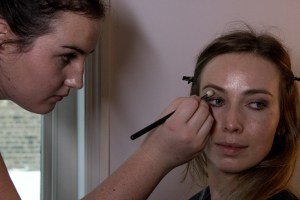
Beccy Whyte, MUA on AOTS’ latest short, ‘The Last Postcard‘, March 2018, applying makeup on Marina Kolokolova. Photo credit Chris Bourton.
The first CAST CALL is at least 15 mins after CREW CALL so the MUA has at least 30 mins to set up (this gives the cast 15 mins to grab a coffee before getting into make-up). In my experience, most MUAs will turn up 30 mins before their call time, because they assume the AD didn’t factor in the MUA’s set up time.
Francesca Ioppolo puts makeup on Joanna Pope for ‘The Darkness Without‘ Photo credit Chris Bourton
Every meal break has to be 60 minutes (as per every film union). What I do, however, is trick people (damn, here’s the secret…). You see 45 mins into the meal break is “Cast in MU”. Cast and MU can start their meal earlier so they get the full 60 mins. The last 15 mins of the break (when Cast is in MU) is so 1) the cast can have their make-up reapplied (I learnt that the hard way on my first film shoot); and 2) so the crew can faff (going to the loo, making a cup of coffee, slowly making their way back to the kit). It’s a faff buffer time.
Catering for ‘Locked In‘
Always when scheduling, allow buffer time. Lots and lots of buffer time. Because what can go wrong, will.
How many meals do you have to have?
It depends how long your shoot day is. For a 14-hour day, two meals (lunch, dinner). For a 10-hour day, one meal (lunch). For up to a six-hour day, people can sort themselves out for food – but make sure you have heaps of snacks so they can fill up.
If you’re shooting around 7 or 8pm, I think you should feed people dinner. Everyone gets hungry around dinnertime. The same for 1pm-3pm for lunch.
Me and Daniele catering for ‘Locked In‘
I always teach my students that their crew can’t go 5 hours without a meal. However, I was on a 12-hour shoot recently (9am-9pm), and there was only one meal (lunch) at 2pm. The rationale is that five hours without a break is industry standard. 9am-2pm, one hour, 3pm to 8pm, but that they could push the extra hour by providing snacks so the crew can eat in that final 6 hours. I know from experience that dinner can add extra time when people just want to go home earlier. I’ll leave it up to your judgement.
When you’re producing a film, you’ve got to create three budgets.
Low- budget
The low- budget is the absolute minimum you can make your film for.
You’re shooting with whichever equipment you can borrow or already own (the cheapest you can get);
you’ve got the bare minimum crew;
which could be you with your camera phone;
you’re using whichever locations you can get for free (like your house);
no-one is getting paid.
The thing to remember is that no-one should incur costs from working on your film. If you aren’t paying them, then you have to cover their transport costs and feed them. In your low- budget, your highest costs are catering, transport, and insurance (you could try to avoid insurance, but that could cost you way more in the long run).
High- budget
The next to calculate is the high- budget. It’s the “pie-in-the-sky”, “if you had all the money in the world”, ideal scenario. There is no upper limit. In the high-budget:
you have the absolute best top quality equipment;
you have all of the crew you could possibly need;
you’re paying full rate for the best locations;
everyone is getting paid their union rate (see BECTU for crew rates).
Your highest cost is going to be crew fees. Then it trickles down to catering, transport, insurance, equipment, and locations.
Medium- budget
The medium- budget is likely what your budget will end up like. In it:
you mix what equipment you can borrow with what you will need to hire;
you work out who you will need on set for the most efficient amount of time;
e.g. if you have to have a stunt co-ordinator, you get all the stunts in one day; you have a full camera department when there are complicated scenes, but minimal crew other days.
you are likely looking for free locations, but have some funds set aside for hiring if needed;
you work out who you need to pay and how much.
some people may get NMW (national minimum wage); some inexperienced crew roles you may ask to work for free (e.g. runners);
Your highest costs for this budget will be, as above, crew rates; catering; transport; insurance; equipment; and locations.
Before anyone gets upset: I’m not going to get into the “not paying people”, “asking people to work for free” debate now, but will in a different post.
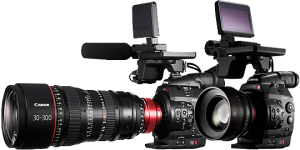
To give you an idea of how this works, let’s look at cameras:
High- budget: digital: Arri Alexa; RED Dragon; film: 16mm; 35mm
Or your camera department:
Low- budget: DP
Medium- budget: DP, 1st AC, 2nd AC
High- budget: DP, Camera Operator, 1st AC, 2nd AC, 3rd AC
Once you have your three budgets, you have your range: the minimum your film can be made for; the maximum; and the safe middle-ground.
But why can’t I just make one budget?
Producing is all about troubleshooting and problem-solving. When being thorough with your budgets, you are working through all possible scenarios. This will help you to understand your film’s needs at a deeper level because you have done the figures. An HOD asks for more crew? You have done the figures and know whether it is possible or not. The location costs more than expected? You can work out where to minimise costs in other areas.
You can also use the budgets to your advantage:
when funding, which budget are you trying to raise?
when a location asks for your budget, which do you send?
Budgets are vitally important to a successful film’s production. It takes practice. Remember that this is only one stage of budgeting; the budget will be revisited throughout the film’s production.
Check with your cast and crew whether they have an IMDb page first.
A spreadsheet will help you. So will having your film open in a tab with the credits.
You have to have an official website for your film.
You should already have your film online.
Anyone can submit to IMDb, but having IMDbPro and Contributor Status helps get your films approved quicker and easier.
Another few points (that I don’t think I made in the video)
don’t create an IMDb page until you have shot your film. Even though you can create an ‘in development’ page, it is really hard to remove a credit from IMDb if someone drops off the project last minute. If you wait until your film is finished, the credits will be correct.
Have a portrait poster image.
Adding a thumbnail poster to your IMDb page makes the film look 100%* better for everyone involved.
IMDb thumbails are portrait (rather than landscape), so make sure your film title works portrait.
Because it’s a thumbnail, it is going to be very small. So you don’t need the credit block or lots of writing on your poster.
With AOTS, we have started creating poster thumbnails specifically for IMDb. Below we have two versions of the poster from our June 2017 Action On The Side project, ‘Exposure‘
The IMDb poster
The poster with credit block
Now, check the IMDb page for Exposure here. Click the pages for some of the Cast and Crew: doesn’t it look better on their page? The thumbnail really adds to their pages.
Recently I even went back and created thumbnails for some of my earlier films, using Canva.com.
Creating a poster is vital for your films. (I’ll write another blog post on this soon.)
Good luck creating IMDb pages for your film!
*or 150% or 200% or 1000% — I hate hyperbole when it comes to percentages. Also, that’s a made up number. Just — it makes your film look more professional and way better.
It’s been a long time since I updated my blog. I’m on set for our March 2018 Action On The Side short film, The Last Postcard. As Producer, I’ve organised everyone to be here: the cast, the crew, the location, the budget. As on-set DIT, I receive the footage and sound files and save it onto three different hard drives. As the Organiser, I’m in charge of the skills development of the project. People taking part benefit from my teaching on film production techniques, so they can become better filmmakers (part of the AOTS USP).
Here’s me showing Adriana some script supervision techniques. Photo by Stine Olsen.
I learn something new on every film shoot. So far I’ve learnt that there’s no way of knowing when the building will hire someone to steam clean the carpets (on a weekend no less!). Every AOTS iteration I invest in something to make life easier in future: for this month, we have lids on our cups (sustainable and safe); I’ve developed more resources (like a Director’s checklist, a location recce checklist, and a chain of title checklist); and now we have three AOTS External Hard-drives.
We’re shooting in a beautiful flat in Holland Park. Gavin, the DP, is shooting on a BMCC, with an external monitor.
Isabella Stevenson-Olds on the monitor
Overall the shoot is going well. I’m looking forward to see the finished film in two weeks’ time.
This is a free event on 10 November 2017 in Torino, Italy.
‘Copper’ will represent the Best of the Fest from CineDeaf 2015, where we had our Italian premiere. CineDeaf have a special collaboration with the Divine Queer Film Festival and recommended ‘Copper’.
Congratulations to everyone involved in the project. Now to update the IMDb page…